

A few weeks ago I talked about what’s changing for individual engineers: how writing code is giving way to directing it, and how the job is less about knowing syntax and more about knowing what you actually want to build.
That naturally leads somewhere uncomfortable: if the engineer’s role is changing that much, what happens to the rest of it? The team structure? The org chart? The way you hire, measure, and ship?
The short answer is that the old model (that familiar pyramid of Dev, QA, and Ops, held together with ticket queues and sprint ceremonies) isn’t just getting updated. It’s getting replaced. Not with chaos, but with something that looks a lot more like a living system than an org chart.
I’ve been calling this the Cellular AI Org Model, and it’s the clearest mental model I’ve found for explaining what future-built engineering organizations actually look like.
Why the Pyramid Stopped Working
The pyramid made sense once. You needed CSS specialists, database experts, QA engineers who could write test scripts. Specialization was how you managed the complexity of building software. Divide the knowledge, divide the labor.
The problem was always the handoffs. Every boundary between specializations was a point where things slowed down, context got dropped, and miscommunication crept in. Agile tried to fix this by adding ceremonies on top: standups, sprint reviews, retrospectives. But ceremonies don’t fix structure; they just make the wait feel more organized.
What changes that calculus entirely is when a single AI agent can take a well-scoped prompt and come back with a working component, its tests, a flagged security issue, and a proposed deployment config. At that point, the rationale for four separate specialist teams doesn’t really hold up. You need a team organized around the outcome, not around who knows which tool.
The Cellular AI Org
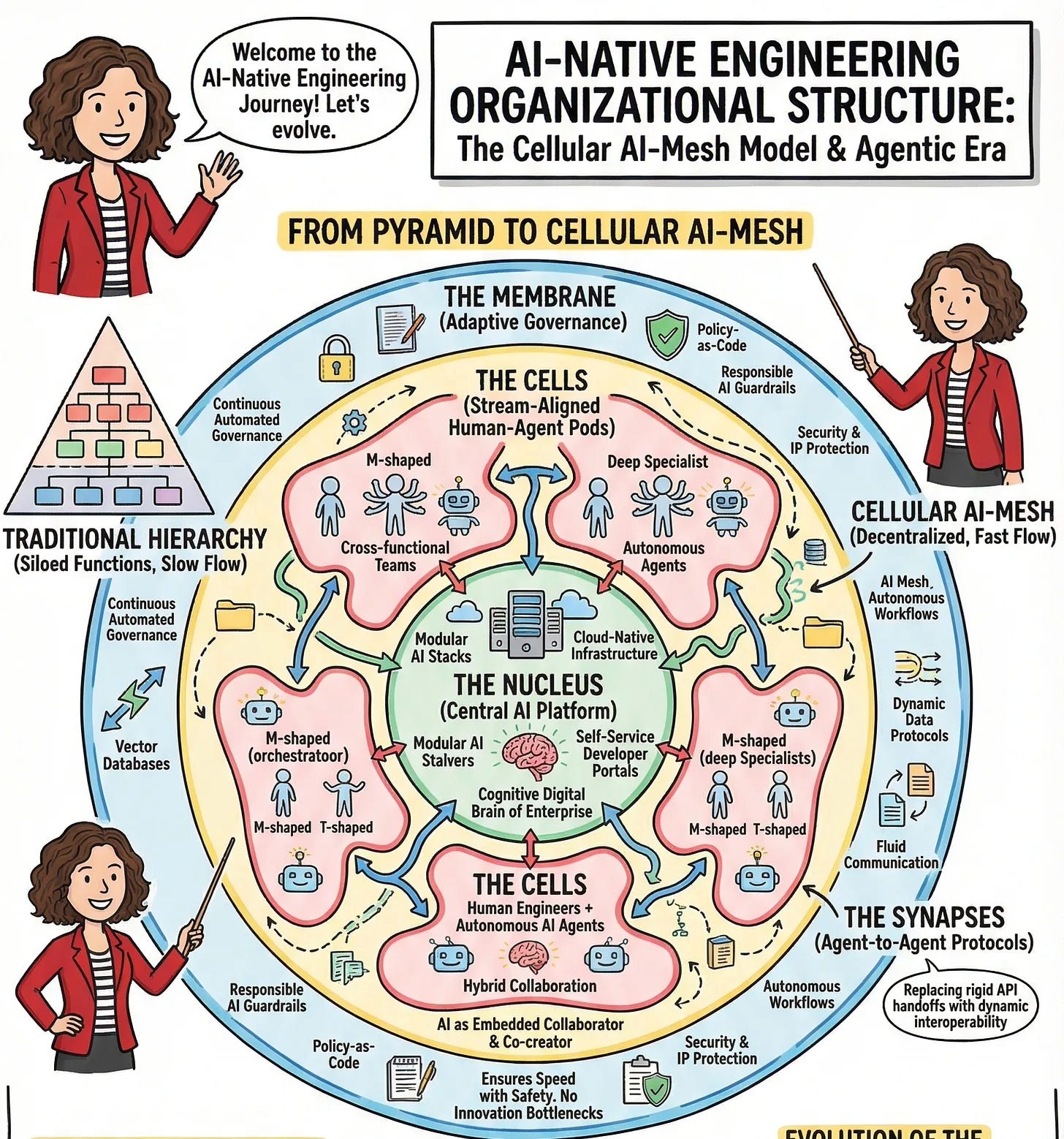
Picture the new engineering organization in four layers, like a cell under a microscope.
🧬 The Nucleus: Your Central AI Platform
In the middle sits what platform engineering is becoming, and it’s a lot more than pipeline management and Jenkins configs.
The Nucleus is the shared foundation that every team in your organization draws from. It houses the LLM pipelines with guardrails already built in (not just raw API keys passed around in Slack). It holds your RAG infrastructure, so that when agents work, they’re grounded in your actual codebase, your actual docs, your actual past decisions, not hallucinating from general training data. It makes governance executable code rather than a PDF someone last edited in 2022.
The goal is that any product team can plug in and use AI capabilities without having to become an AI infrastructure team themselves. That’s the leverage. Gartner thinks 70% of organizations with platform teams will have this in place by 2027. Whether that timeline is right or not, the direction is clear.
🔴 The Cells: Small Teams, Full Ownership
Around the Nucleus are the Cells: cross-functional, outcome-focused teams that own a product area end-to-end.
This is not your Agile squad with a Jira board. The Cell doesn’t hand work to QA. It doesn’t wait for a release train. It ships. Requirements, code, tests, deployment, observability, all of it lives inside the Cell.
Inside each one, you’ll typically find two kinds of people:
M-shaped engineers who can move fluidly across domains. The ones who can talk to the product manager in the morning, review infrastructure decisions at lunch, and course-correct an agent’s output in the afternoon. They’re orchestrators more than implementers.
T-shaped specialists who go very deep in one area. The algorithm that can’t be prompted into existence, the domain logic where institutional knowledge matters, the security surface that needs a human who actually understands what they’re looking at.
Working alongside both are autonomous agents that run continuously: generating code, writing tests, flagging anomalies, surfacing options. They don’t wait for a ticket. They’re part of the team’s daily operation.
The research backs this up pretty clearly. Augmented workers on knowledge-intensive tasks completed 12.2% more work, moved 25.1% faster, and produced results rated over 40% higher in quality. The performance gap between teams that figure out this human-agent pairing and teams that don’t is going to be hard to close once it opens.
⚡ The Synapses: How Cells Talk to Each Other
In the old world, systems talked through rigid APIs, contracts that took months to negotiate and even longer to update when something changed.
In this model, the connections between Cells are more fluid. Think of a scenario: the Growth team’s agent spots a conversion drop in onboarding. Instead of filing a ticket and waiting two sprints, it queries the Core Product team’s agent directly, pulls the relevant context, and surfaces a proposed fix for a human engineer to review before anything merges.
This is what the Model Context Protocol (MCP) is enabling: a shared language for agents across different systems and teams to exchange context without a human relaying information between them. It’s early, but organizations replacing rigid point-to-point integrations with this kind of dynamic protocol are reporting that it cuts out months of manual engineering effort. The maintenance burden alone is worth the migration.
🛡️ The Membrane: Governance That Actually Keeps Up
The outer layer is where most organizations underinvest, and then pay for it later.
The Membrane is not a compliance committee or a quarterly security review. It’s continuous, automated governance that runs at the same pace the Cells operate. Policy as code. Not policy as document.
The risks here are genuinely new and worth taking seriously:
In a multi-agent system, one wrong output doesn’t just affect one decision. It gets passed downstream, treated as fact by the next agent, and propagates through the system before anyone notices. Root-causing that kind of error is miserable work. The Membrane catches it before it spreads.
There’s also the license problem. Foundation models are trained on public code, and they can generate snippets that reproduce GPL-licensed logic without flagging it. You integrate that into a commercial product and your IP situation gets complicated very fast. Automated scanning before anything reaches a production branch isn’t optional at this point.
And model drift is real. Your agents will behave differently over time as models update and context shifts. Without continuous monitoring, you don’t know when that drift has moved outside acceptable boundaries.
Organizations that get this layer right see 40% fewer AI-related security and ethics incidents than those that don’t, according to Gartner. It’s not the exciting part of the model, but it’s what keeps the whole thing from coming apart.
The SDLC Isn’t Getting Faster. It’s Getting Different.
There’s a framing I hear a lot: that AI is “accelerating” software development. I think that’s technically true and practically misleading, because it suggests the process is the same, just quicker. It’s not.
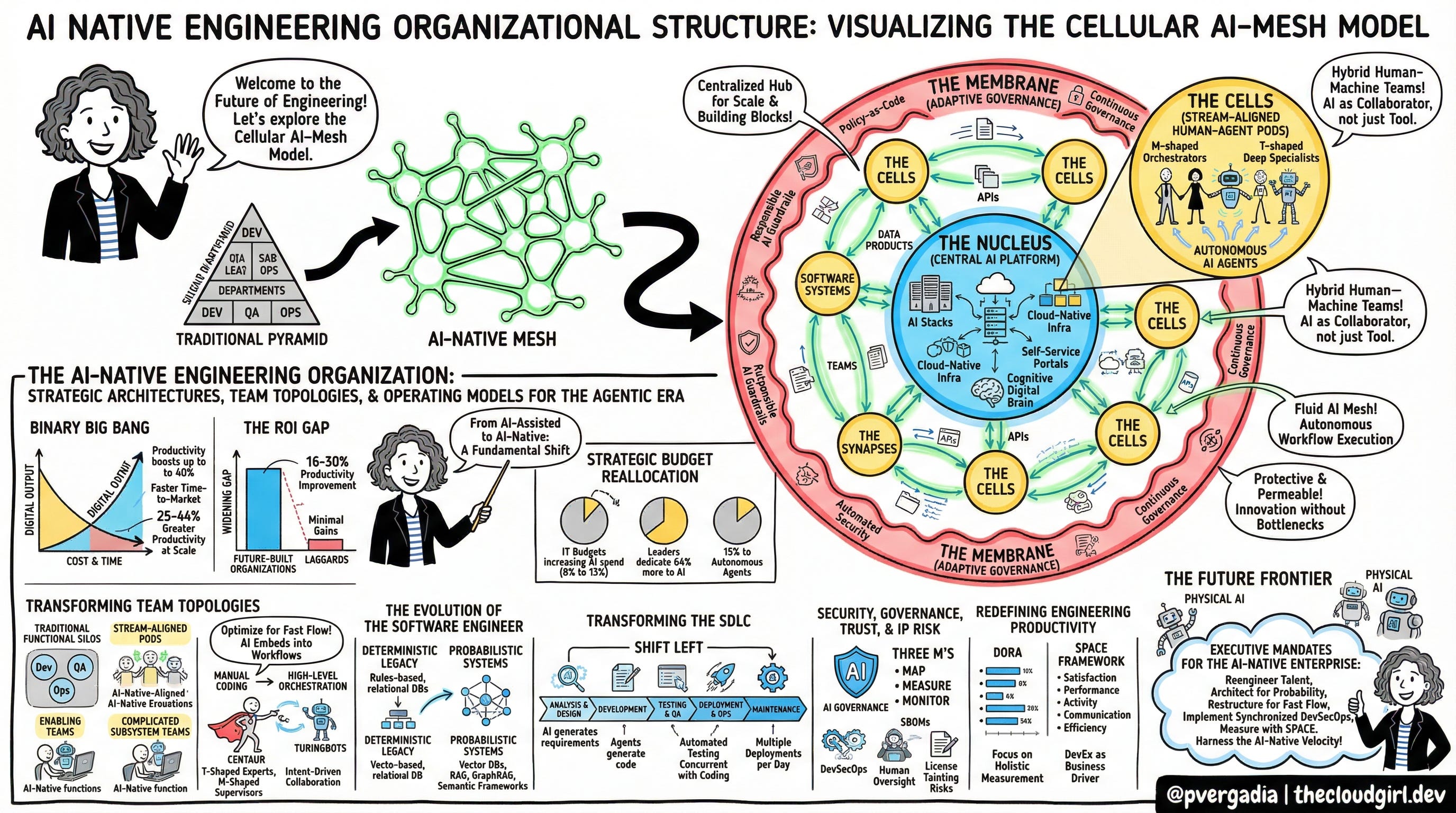
Requirements and design used to mean weeks of workshops and documents. AI agents can now take a natural language brief and generate requirements, architectural proposals, and wireframes in minutes. The work shifts from writing all of that down to reviewing and shaping it.
Development used to mean a developer staring at a blank file. Today’s coding agents (Cursor, Windsurf, Claude Code) can sustain over two hours of continuous, complex work with roughly 50% confidence of producing something correct. That window is doubling roughly every seven months.
Testing used to be a phase that kicked in after the code was done. Now it runs in parallel. AI generates test cases and predicts failure points as the code is being written. By the time a human reviewer touches the diff, basic coverage is already there.
Deployment used to involve release trains and change advisory boards and weekend maintenance windows. Multiple deploys per day is achievable now not because people are moving faster, but because the release automation itself is smarter.
Maintenance is maybe the least appreciated change. Instead of scheduling tech debt sprints, agents scan for vulnerabilities, refactor legacy code, and flag drift continuously. The codebase improves in the background.
None of these phases disappeared. But who does what in each one looks pretty different.
Measuring What Actually Matters
If you’re still tracking lines of code, commit counts, or story points, you’re measuring the wrong thing. You’ve always been measuring the wrong thing. AI just makes the mismatch more obvious.
Developers spend about 24% of their time writing code. The rest is design, communication, architectural judgment, figuring out what to build and why. AI speeds up the 24%. It doesn’t touch the 76%. So measuring output volume has never been a proxy for value, and treating it as one now will lead you somewhere you don’t want to be.
The SPACE framework (Satisfaction, Performance, Activity, Communication, Efficiency) gives you a better picture. Teams that measure across all five dimensions show 20-30% better overall output because they find the friction that pure velocity metrics hide.
Developer Experience matters here more than people tend to admit. Teams with a strong DevEx are 33% more likely to hit their business outcomes and 31% more likely to improve delivery flow. Organizations that invest in it are twice as likely to retain their best engineers, and right now, engineers who can actually orchestrate AI workflows well are genuinely scarce.
What To Do About It
Five things I’d push on if I were making decisions right now:
Build the Nucleus first. Giving every team their own AI budget and letting them figure it out independently sounds empowering. In practice it creates fragmented tooling, duplicated infrastructure costs, and governance gaps that are hard to close later. Build the shared platform first. Give teams self-service access from a common foundation.
Change how you define “senior.” Seniority that’s mostly about knowing a language deeply is going to matter less. Systems thinking, judgment, the ability to direct agents toward a clear outcome, those are what you want to hire and promote for.
Treat governance as an engineering problem. Manual review of AI outputs doesn’t scale. Guardrails, license scanning, drift monitoring: these need engineers building automated solutions, not lawyers reviewing things by hand.
DORA is not enough anymore. Keep it for pipeline health. Add SPACE metrics. Make Developer Experience something that shows up on the same dashboard as revenue and uptime.
Talk openly about the capability frontier. The most dangerous thing isn’t AI failing on tasks it knows are hard. It’s AI being confidently wrong on tasks that look easy but aren’t. Build escalation paths. Keep humans accountable for architectural decisions and anything hard to reverse.
One Last Thing
The pyramid was built for stability. You hired specialists, defined their lanes, and optimized for consistent, repeatable output in an environment that changed slowly.
That environment is gone.
The organizations that will do well over the next decade are the ones that can adapt: handle ambiguity, absorb new tools, and change direction without everything breaking. The Cellular AI Org is a different theory of what engineering organizations are for.
The teams that figure this out first will be playing a different game entirely.
Research drawn from McKinsey, Gartner, BCG, Deloitte, Accenture, Forrester, and the academic literature on the SPACE framework and Team Topologies.