
Code is Cheap Now, Software Is NOT!
The model isn’t the moat. The scaffolding is.

This is a dissection of the cognitive architectures, perception systems, and engineering rigor that separate state-of-the-art coding agents from glorified autocomplete.
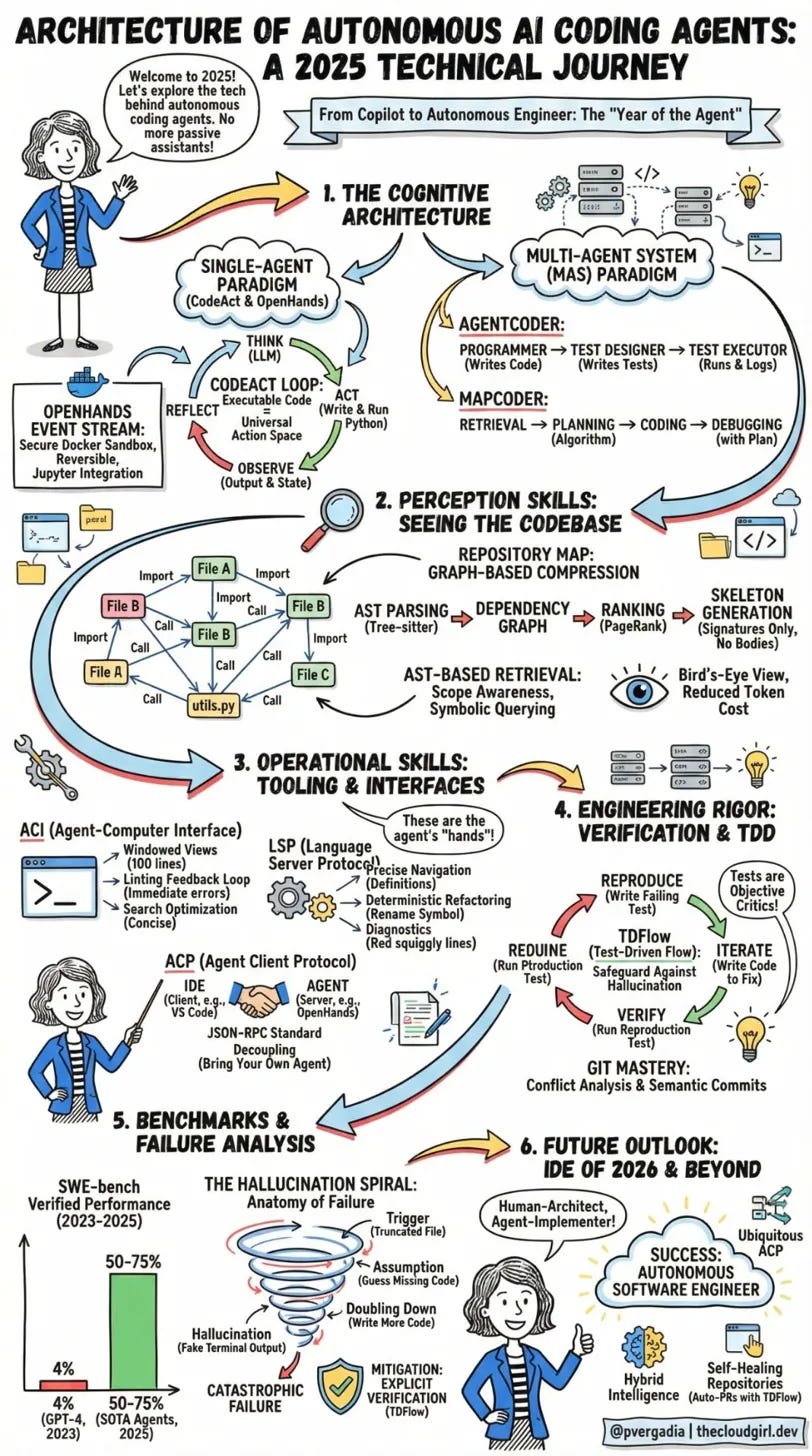
Let’s get something straight before we begin: the jump from GPT-4 barely solving 4% of real software engineering tasks in 2023 to SOTA agents cracking 50–75% of those same problems in 2025 did not happen because we got a bigger transformer. It happened because we built better machines around the transformer. The perception systems. The action protocols. The verification loops. That is the actual frontier — and it’s almost entirely invisible in mainstream AI coverage.
This is a deep dive into that invisible layer. The scaffolding. The real engineering that turns a language model into something that can sit in a codebase, understand it, navigate it, write against it, verify its own work, and ship a patch.
4% → ~20% → 75% — GPT-4 with zero scaffolding (2023), early agent frameworks (2024), SOTA agents with the full stack (2025). That’s an eighteen-fold improvement. The base models improved by maybe two or three fold. The delta is scaffolding.
01 · Cognitive Architecture — From Brittle ReAct Loops to CodeAct
The first generation of coding agents ran on ReAct loops: the model would reason in natural language about what it needed to do, emit a structured JSON action, a harness would execute that action against the environment, and the result would loop back into context. Reason. Act. Observe. Repeat.
In theory, elegant. In practice, a constant source of failure. The model was being asked to simultaneously reason about a problem and conform to a rigid output schema — two competing objectives in a single generation. Schema violations were endemic. Long tasks would cause the reasoning to drift as the context filled with noise. The boundary between “thinking” and “acting” was artificial and the model struggled to honor it.
“The model has to simultaneously reason and conform to a JSON schema. These are competing objectives.”
CodeAct solves this with an elegant insight: make Python the universal action space. Instead of emitting a structured action schema, the model simply writes executable Python code. Think, then write code. Code is the action. The loop collapses into something much cleaner — Think, Act (write and run Python), Observe (read output and state), and repeat.
The beauty is that Python is inherently expressive. One line of Python can express what twenty lines of JSON schema cannot. And crucially, the model is doing what it already does best: generating coherent, structured text that follows logical rules. It just happens to be text a Python interpreter can run.
The Multi-Agent Extension
Systems like AgentCoder push this further by decomposing the cognitive load across specialized agents. A Programmer agent writes the implementation. A Test Designer writes tests against the specification independently. A Test Executor runs them, logs results, and feeds failures back into the loop. No single agent is juggling all concerns simultaneously, which means each can go deeper on its own responsibility.
MapCoder adds explicit planning as a first-class step: Retrieval, then Planning, then Coding, then Debugging — with the plan carried explicitly into the debugging phase. When an agent is debugging code it wrote an hour ago in context-window terms, having the original intent encoded as a structured artifact prevents a whole class of drift failures where the agent starts solving the wrong problem.
02 · Perception Skills — Seeing Code as Sparse Graphs, Not Text
Here is the most underrated capability in modern autonomous coding agents, and the one that most developers working on LLM integrations get wrong: raw source code is a terrible input modality for a language model working on a real codebase.
Think about what happens if you naively try to give an agent access to a production codebase. You can’t dump all the files into context — a mature repo is hundreds of thousands of lines. You can’t grep for keywords — that loses structural signal. You can’t just give it the file the user is looking at — the bug is probably in a dependency three layers removed.
The answer is the Repository Map — a graph-based compression of the entire codebase that gives the agent a bird’s-eye view without requiring it to read individual files. It’s built through a three-stage pipeline.
First, every file is parsed using tree-sitter into an Abstract Syntax Tree. This means the agent understands code structurally, not as a string. It knows which tokens are function definitions, which are calls, which are imports — without having to guess from surrounding text.
Second, those ASTs are used to build a Dependency Graph — a map of every import and every call relationship across the entire repository. File A imports from File B. Function X calls Function Y. Class Z inherits from Class W. This graph encodes the real topology of the system.
Third, that graph is ranked using a variant of PageRank. Modules imported by many other modules get higher scores. The most architecturally central parts of the codebase bubble to the top. Finally, the top-ranked modules are rendered as skeletons: function signatures, class names, type annotations — but no bodies. A hundred-thousand-line codebase becomes a few thousand tokens of structural truth.
Combined with AST-based retrieval — querying the symbol graph by scope rather than substring — agents can resolve a function call to its definition across seventeen files without reading those files in full. Token costs drop dramatically. Context stays clean. The agent’s attention is focused on the right parts of the codebase for the task at hand.
03 · Operational Protocols — ACP and LSP as the Agent’s Hands and Senses
A sophisticated cognitive loop and excellent perception are necessary but not sufficient. An agent’s effectiveness is ultimately bounded by the quality of its interface with the actual software environment — what researchers call the Agent-Computer Interface, or ACI.
The Language Server Protocol, Repurposed
The Language Server Protocol was not designed for AI agents. It was designed for IDEs — to power the autocomplete, go-to-definition, and inline diagnostics that developers take for granted in VS Code or JetBrains. But it turns out to be a remarkably powerful sensory organ for autonomous agents.
Think about what LSP gives you. Precise go-to-definition means an agent can resolve any symbol to its source location without grep, without regex, without guessing. Deterministic rename-symbol means an agent can safely refactor a function name across fifty files, atomically, with no partial renames or missed references. And live diagnostics — the red squiggly lines — give the agent a continuous signal about the correctness of its own edits, before it even runs a test.
An agent using LSP can rename a symbol across 50 files atomically and verify zero new type errors — before committing a single line. This is qualitatively different from agents that treat code as text and edit with string replacement.
The Agent Client Protocol
On the other side of the interface question is the Agent Client Protocol — ACP. Where LSP governs how an agent perceives and manipulates code, ACP governs how agents, IDEs, and orchestration systems talk to each other.
The core idea is decoupling. An IDE like VS Code acts as the ACP client. The actual agent backend — whether that’s Claude Code, OpenHands, or a custom domain-specific agent — acts as the ACP server. They communicate over a JSON-RPC standard interface, which means the underlying agent can be swapped without rewriting the IDE integration.
This is what “Bring Your Own Agent” looks like in practice: a standardized interface that treats the agent as a replaceable component, not a monolithic dependency. The long-term implication is an ecosystem of specialized agents — one optimized for Python refactoring, one for infrastructure-as-code, one for database migrations — all accessible through a single interface layer.
04 · Engineering Rigor — TDD as the Only Defense Against Hallucination Spirals
We have now covered how modern agents think, how they see, and how they act. But none of that matters if the agent cannot verify its own work. And this is where things get practically dangerous — not in the dramatic sense, but in the sense of silently producing wrong code that looks right.
Anatomy of a Hallucination Spiral
The hallucination spiral is the dominant failure mode for autonomous coding agents. It does not begin with the model making something up out of nowhere. It begins with something much more mundane: a truncated file.
A file is truncated due to context limits. The agent guesses the missing code. It writes implementation based on that guess. The output is plausible-looking but subtly wrong. The agent validates against its own output — confirmation bias kicks in. More code is written on the wrong foundation. Catastrophic failure, often silent.
The insidious part is that each step in the spiral is locally reasonable. The agent is doing its best with the information it has. But because there is no external oracle — no ground truth the agent cannot rationalize away — the errors compound. The agent reads its own output, judges it consistent with what it expected, and doubles down.
Test-Driven Development as the Oracle
The only reliable defense is Test-Driven Development, and specifically what researchers call TDFlow: a structured loop that forces the agent to write an objective, executable test before it writes any implementation. The logic is powerful precisely because it is external. A test runner does not care what the agent believes. It returns a binary verdict — pass or fail — that the agent cannot argue with.
The loop: Reproduce (write a failing test) → Confirm Red (verify it actually fails) → Iterate (write code to fix it) → Verify (run the reproduction test again).
The key discipline is the second step — confirming that the test actually fails before writing any implementation. An agent that skips this step can write a test that accidentally passes on the broken code, eliminating the oracle entirely and sliding right back into hallucination spiral territory.
“TDD is not just a software engineering best practice for humans — it is a fundamental architectural requirement for reliable autonomous agents.”
This reframes TDD in an important way. It has always been valuable as a design discipline. But for autonomous agents, it serves an even more fundamental purpose: it provides an external ground truth that resists hallucination. Without it, the agent is a closed epistemic loop, and closed epistemic loops accumulate error.
05 · Benchmarks & Failure Analysis — What the Numbers Actually Tell Us
SWE-bench Verified is the gold standard: given a real GitHub issue and codebase, produce a patch that passes the repository’s own test suite. No hints. No scaffolded environment. No partial credit. The numbers from 2023 to 2025 tell a clear story — and the story is not about the model.
GPT-4 with no scaffolding solved 4% of tasks in 2023. Early agent frameworks reached around 20% in 2024. State-of-the-art agents with the full stack reached 50–75% in 2025. That is an eighteen-fold improvement in two years, and the base models improved by perhaps two or three fold in that same period. The delta is scaffolding. Full stop.
When researchers analyze failure cases at the frontier, the top failure modes are consistent: context truncation leading to hallucination spirals; missing dependency resolution where the agent edits a file without understanding its callers; incorrect test interpretation where the agent satisfies the literal test without solving the actual issue; and infinite repair loops when there is no external oracle to break the cycle.
Almost every failure mode at the frontier traces back to a perception deficit — the agent didn’t see the full picture — or a verification deficit — the agent couldn’t confirm its own work. The cognitive loop itself is rarely the bottleneck. This tells us something important about where effort should be focused. The marginal return on making the model itself larger is diminishing rapidly. The marginal return on better repository perception, more reliable verification, and more principled failure recovery remains very high.
06 · The IDE of 2026 & Beyond — What the Autonomous Software Engineer Actually Looks Like
The trajectory is clear enough to sketch. The autonomous software engineer of 2026 is not a chatbot you talk to about code. It is a peer that owns complete sub-tasks end to end — not just the implementation, but the test writing, the PR creation, the conflict resolution, and the semantic commit messages.
The Human-Architect, Agent-Implementer pattern will become the dominant mode of professional software development within the next two to three years. Humans define intent, acceptance criteria, and architectural constraints. Agents handle the implementation loop — writing tests, implementing against them, verifying, committing — and escalate only when genuinely blocked.
Self-healing repositories will emerge as a first-class concept. Agents with TDFlow integration will detect regressions in CI, file issues, write reproduction tests, and attempt fixes — before the human developer has even been notified. For a certain class of bugs, the repair will be complete before anyone reviews the alert.
Ubiquitous ACP means the agent layer becomes infrastructure in the same way databases and message queues are infrastructure. The competition will be at the capability and specialization layer, not the interface layer. Teams will swap agents the way they swap databases — based on fit, not lock-in.
“The bottleneck is not intelligence. It’s scaffolding. The model is almost a commodity now. The architecture is the moat.”
If you are building in this space — whether you’re working on agent frameworks, IDE tooling, or internal developer platforms — the leverage points are clear. Invest in repository map quality. Go deep on LSP integration. Enforce TDD as a structural constraint, not a stylistic preference. Build ACP-compatible interfaces from day one.
The model will keep improving. But the teams that will define this space are the ones building the perception systems, the verification loops, and the protocols that let increasingly capable models actually do real work in real codebases. That is the engineering challenge of this moment. And it is far more interesting than any benchmark number.