
DevOps vs LLMOps vs MLOps: The Evolution
Stop Trying to Force DevOps on Your LLMs: The Evolution to LLMOps

If you’ve been in the tech game for a while, you remember when DevOps changed everything. It took us from “throwing code over the wall” to automated, reliable pipelines. But if you are part of the wave of engineers currently rushing to build GenAI applications, you might be hitting a wall.
Here is the hard truth: You cannot strictly DevOps your way into AI success.
Industry data suggests that historically, 88% of ML initiatives have struggled to reach production when relying on traditional practices. Why? Because while the code might be fine, the problems are fundamentally different.
Let’s break down the evolution from DevOps to MLOps, and finally to the new frontier of LLMOps, using the “Hero Guide” framework to see why your stack needs to change.
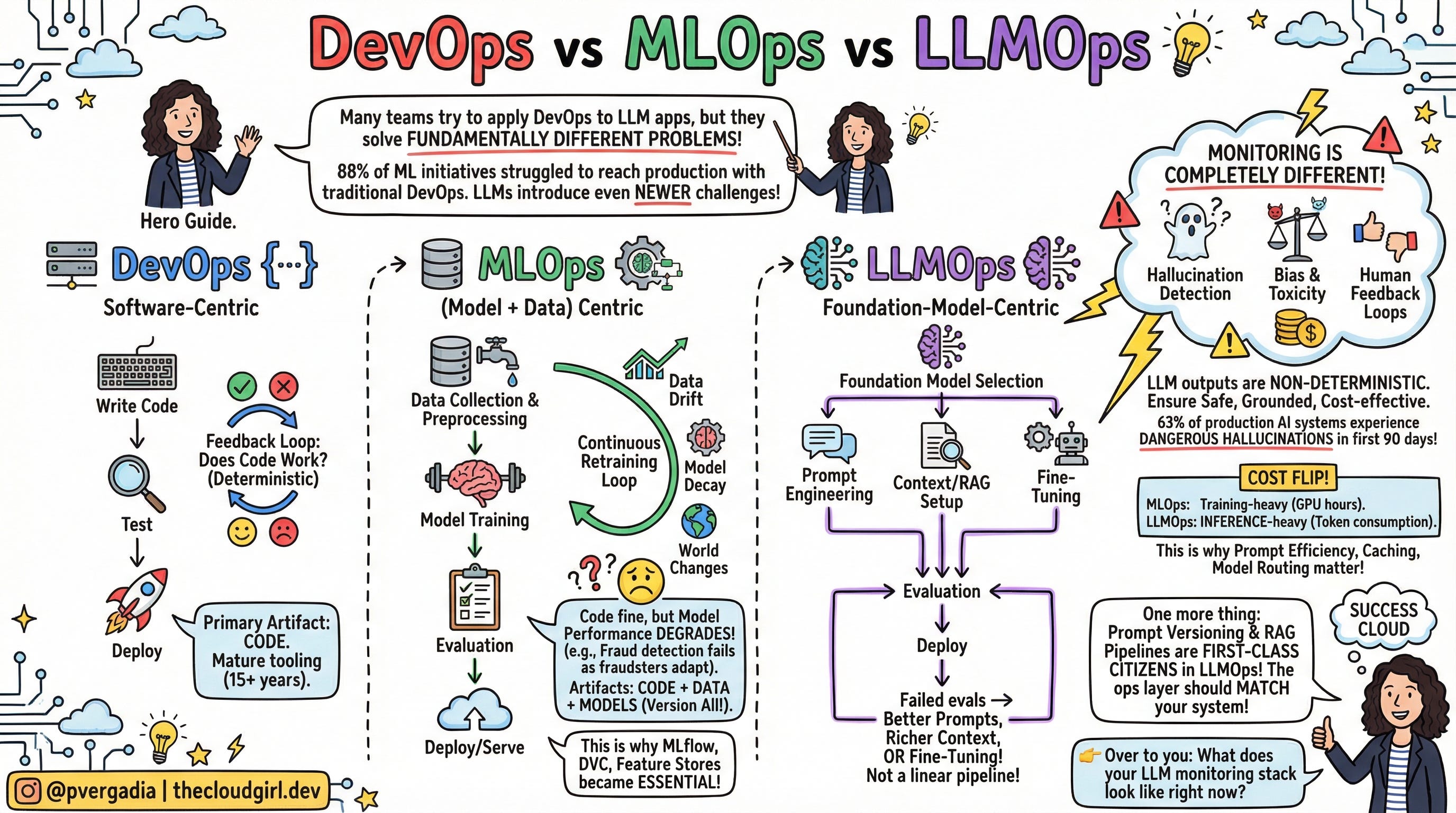
1. DevOps: The Predictable Assembly Line
Focus: Software-Centric —> { Code }
Think of traditional DevOps like a car manufacturing plant. You have a blueprint (the code). You send it down the assembly line (the CI/CD pipeline). If the blueprint is correct and the machines are working, you get the exact same car every single time.
The Feedback Loop: It is deterministic. You write code, you run a test suite.
If
Test Apasses today, it should pass tomorrow.If the code compiles, it works.
The Primary Artifact: Code.
The Goal: Consistency and velocity.
We have mastered this. Tools like Jenkins, GitHub Actions, and Docker have made this a solved problem for standard software. But then, we introduced data into the mix.
2. MLOps: The Living Garden
Focus: (Model + Data) Centric —> { Code + Data + Model }
When we moved to Machine Learning, the “assembly line” analogy broke. Why? Because ML models aren’t static code; they are reflections of the data they were trained on.
Imagine you built a fraud detection system for a bank. In DevOps, once you deploy it, you are done until you want to add a new feature. In MLOps, you are never done.
The Problem: The world changes. Fraudsters change their tactics (Data Drift). A model that was 99% accurate last month might be 60% accurate today because the underlying patterns of reality shifted (Model Decay).
The Feedback Loop: It is statistical. You aren’t just checking “did it crash?” You are checking “is it still smart?”
The “Cost” Reality: MLOps is traditionally Training-Heavy. You spend massive amounts of money and GPU hours upfront to train the model.
In this world, tools like MLflow and Feature Stores became essential because you had to version-control the Code, the Data, and the Model artifacts simultaneously.
3. LLMOps: The Orchestrator
Focus: Foundation-Model-Centric —> { Prompts + Context + Foundation Model }
Now we arrive at the current hype cycle: Large Language Models. If MLOps is gardening, LLMOps is like directing an improv actor.
In LLMOps, you usually aren’t training a model from scratch (unless you have a spare $100M lying around). You are selecting a massive Foundation Model (like GPT-4, Claude, or Llama) and trying to get it to behave.
This introduces a completely new workflow that isn’t linear. It’s a complex web of three parallel paths:
Prompt Engineering: crafting the instructions.
Context/RAG (Retrieval-Augmented Generation): Feeding the model the right “memory” from your vector database.
Fine-Tuning: Tweaking the weights slightly for specific tasks.
The “Cost Flip”
This is the most dangerous trap for new engineering teams.
MLOps burns money during Training.
LLMOps burns money during Inference.
Every time your user asks a question, the meter is running on token consumption. This means Prompt Efficiency and Caching aren’t just “nice-to-haves” for performance—they are architectural necessities to prevent bankruptcy.
The Critical Difference: Monitoring the “Ghost in the Machine”
The biggest shock for traditional developers moving to LLMs is Non-Determinism.
In DevOps, if I input 2 + 2, I expect 4.
In LLMOps, I input “Summarize this article,” and I might get a great summary, a mediocre one, or a complete fabrication.
Your monitoring stack has to completely change. You are no longer just looking at CPU Usage or Latency. You are now the “Quality Assurance” department for a creative entity. You need to monitor for:
Hallucinations: Is the model making up facts?
Toxicity/Bias: Is the model being offensive?
Groundedness: Did the answer actually come from the RAG context we provided, or did the model pull it from its pre-trained “memory”?
Conclusion: Your Ops Must Match Your Stack
If you are building GenAI applications today, look at your CI/CD pipeline.
If you are just deploying code, you are doing DevOps.
If you are retraining models on new data, you are doing MLOps.
But if you are building with LLMs, you need LLMOps.
Next Step for You:
Take a look at your current AI project. Do you have a “Prompt Versioning” system in place? If you change a prompt, can you roll it back just like you roll back code? If not, start there. Treat your prompts and RAG pipelines as first-class citizens.
What does your current LLM monitoring stack look like? Are you catching hallucinations before your users do?
This timing is perfect. Could you detail the artifact evolution?
Great breakdown on the cost flip between MLOps and LLMOps. The training-heavy vs inference-heavy distinction is something a lot of teams miss untill they get their first API bill. I've been building some RAG pipelines lately and the whole prompt versioning thing is def underrated, especially when trying to debug why outputs suddenly change. The hallucination monitoring part feels like a whole new discipline compared to standard observability.