
Enterprise AI Gateway Explained Visually
How is AI Gateway different from API Gateway

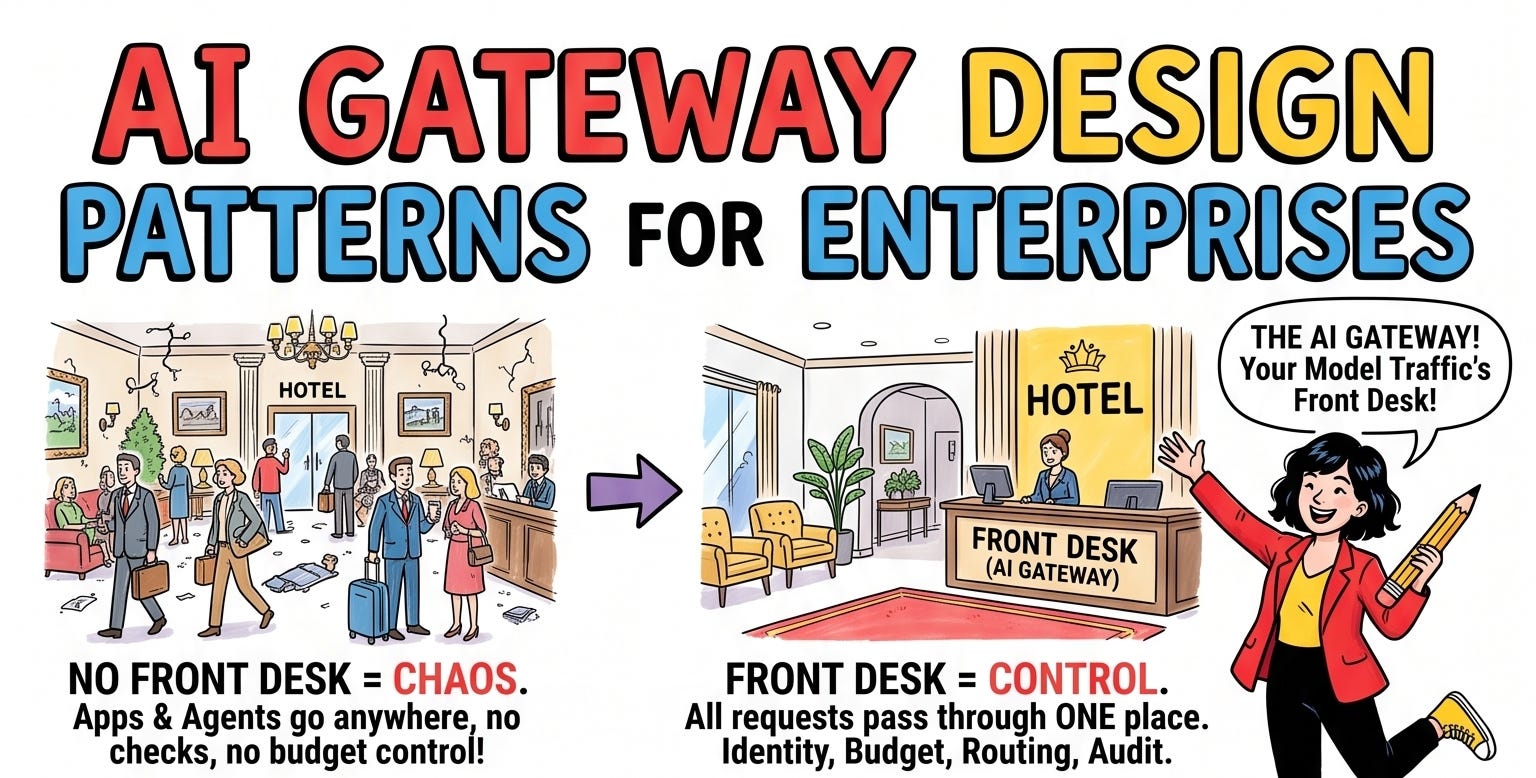
Imagine a hotel with no front desk. Guests wander straight to the kitchen to ask for food, straight to housekeeping for towels, straight to the manager’s office to complain. Every department runs its own intake, checks on its own whether the person in front of it is actually a paying guest, and keeps its own ledger of who owes what. Nobody in the building can tell you what’s happening across all of it at 2am.
A front desk fixes this by becoming the one place every request passes through. It checks your identity once. It knows your room charges. It routes you to the right department. It keeps a single log the whole hotel can be audited against.
An AI gateway is like the hotel front desk for your model traffic.
Every application that wants to call GPT-4, Claude, or a self-hosted Llama model checks in there first. The gateway verifies who’s asking, checks whether they’ve got budget left, decides which “room” actually fits the request, and writes it all down. Nothing reaches an external provider without going through that desk. This matters because the alternative is failure mode at nearly every company scaling past its first LLM prototype. An autonomous agent left running over a long weekend, spawning sub-agents that spawn more sub-agents, each one re-reading the same document and asking a reasoning model to summarize it again, can burn through a quarter’s compute budget in three days. Nobody did anything malicious. There was simply no gate between “an agent wants to call a model” and “the model gets called.”
A traditional API gateway is more like a doorman who checks that you’re wearing shoes.
It counts how many people walk in per minute and blocks obvious troublemakers, but has no idea what a room costs or what you’re planning once you’re inside. LLM traffic needs a front desk, not a doorman, because the “room charges” here are token costs that swing by orders of magnitude between a one-line completion and a fifty-turn agent loop.
The Two-Tier AI Gateway: Four Design pattern
The simplest setup is a single, centralized gateway sitting at the perimeter of the whole company. Every request, from every team, funnels through one cluster. It’s easy to reason about and gives you one audit trail, but it shares the weakness of a hotel with a single front desk serving fifty floors: everyone queues behind the same counter, and if that counter goes down, the whole building stops checking anyone in.
Large organizations tend to split the job into two tiers instead.
