


Most people meet an AI model at the very end of its life. You type into a chat box, an answer comes back, and everything that made that answer possible stays invisible. That works fine until something goes wrong: the model hallucinates, a vendor quotes you a fine-tuning bill, or someone asks whether you should build, buy, or adapt.
Every model you use went through the same four-part journey. It was built on a mountain of text and a cluster of GPUs. It was taught to behave, answer, refuse, and reason. It was tuned to a task and squeezed to fit a budget. And it was shipped, which is where evals, latency, and cost per token decide whether anyone actually uses it.
If you build with AI, knowing that journey is how you stop debugging by guesswork. If you lead, it is how you ask vendors the right questions and know what you are paying for. Most people pick up these pieces out of order, from a blog post here and a demo there, and never see the whole arc.
So I created Life of a Model: Build, Teach, Tune, Ship, a FREE crash course for builders and leaders, based on what I learned building and shipping AI at Google and Microsoft. Six live sessions from November 3 through November 16, all on Zoom, all recorded if you register and can’t make it.
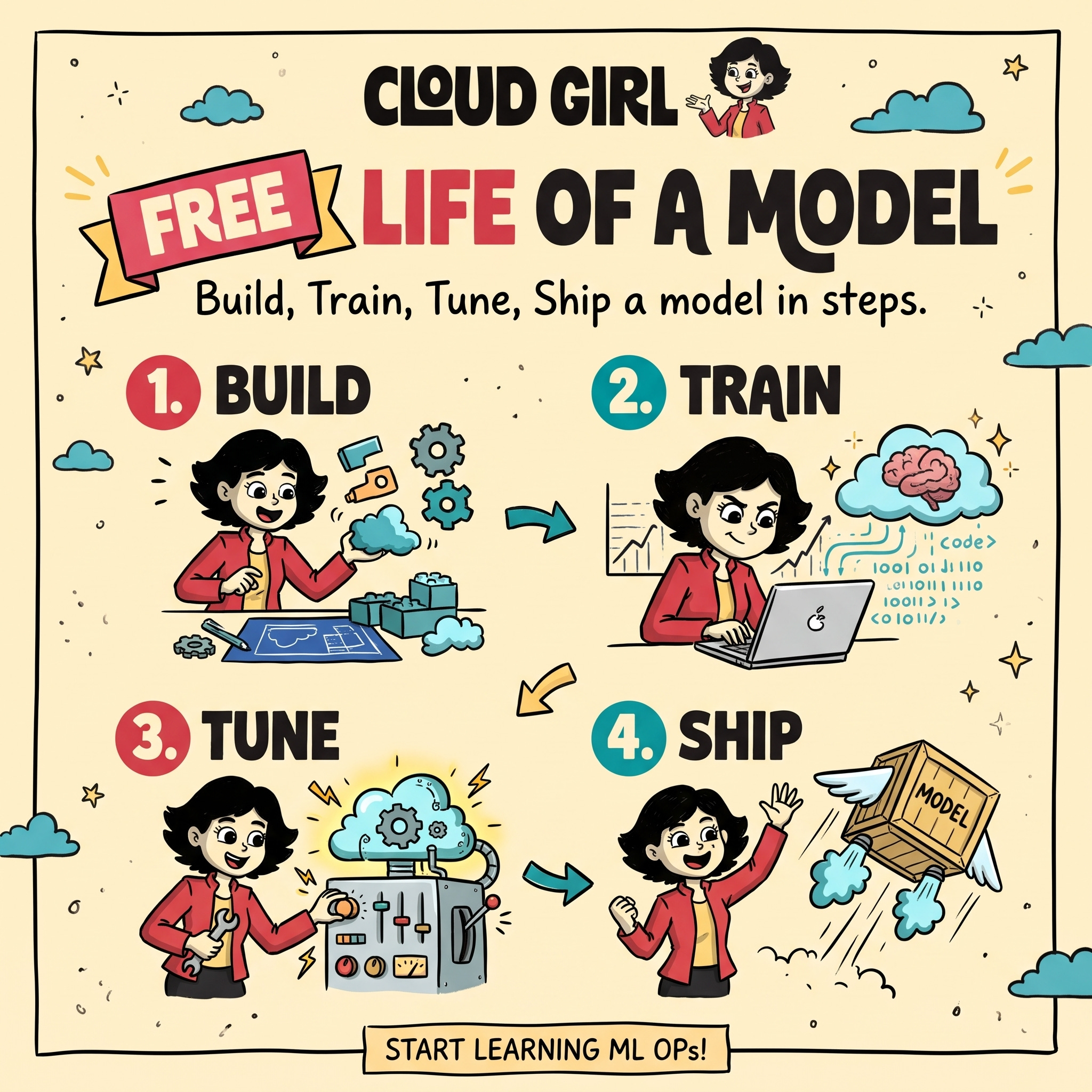
For more details on how the journey works, read on!
Stage 1: Build the model
Build a Model: Pre-Training and GPU Clusters, November 3
Every assistant you use starts life as a base model whose only job is predicting the next token. That one fact explains what an LLM knows, why it hallucinates, and why frontier models cost hundreds of millions of dollars to build. We walk through the data, the training run, and the GPU clusters underneath it all. You’ve cleared this stage when you can explain why a model sounds confident about something it never actually learned, and what that means for the product you’re building or buying.
Stage 2: Teach it to behave
Teach a Model: Post-Training, RLHF, and Reasoning, November 6
A base model knows a lot and behaves badly. It can complete text, but it can’t reliably answer a question, refuse a harmful request, or work through a hard problem step by step. Post-training is where those behaviors get shaped, and it’s the real reason ChatGPT, Claude, and Gemini feel so different from each other. It’s also where the trade-offs between helpfulness and safety get decided. You’ve cleared this stage when you can look at two models and explain why they behave differently, not just notice that they do.
Stage 3: Make it yours, and make it affordable
Tailor a Model: Fine-Tuning, LoRA, and Quantization, November 9
Almost no team trains a model from scratch, but almost every team needs to adapt one and then pay to run it. Fine-tuning and LoRA fit the model to your task. Distillation and quantization fit it to your budget. These are the choices that decide whether an AI feature stays a demo or becomes a product you can serve at a cost the business will sign off on. You’ve cleared this stage when you can say whether your use case needs fine-tuning at all, and what you’d give up to make it cheaper.
Stage 4: Ship it to real users
Launch a Model: Evals, Inference, and Deployment, November 11
A model isn’t done when training ends. Evals tell you whether it’s actually good, and inference and deployment decide whether anyone can use it. Latency, cost per token, and reliability are what make or break an AI product in the real world, and they rarely show up in a demo. This lesson closes the loop: what users do in production becomes the data that starts the model’s next life. You’ve cleared this stage when you can say how you’d know your model got worse last week, and what it costs you every time someone hits enter.
Where this road continues. Stages 1 through 4 give you the full lifecycle as a mental model. The two partner sessions below take specific parts of it hands-on.
Two hands-on sessions with partners
Build Real-Time Voice Agents: Architecture Walkthrough, November 5
A chat window forgives a slow answer. A phone call does not. Once your agent joins a live conversation, half a second of silence feels broken, and a wrong action lands while the caller is still on the line. Habits from text agents don’t carry over. I’m joined by Kris Efland, VP of Engineering at Deepgram, to walk through the architecture choices that decide whether a voice agent earns trust or loses the caller. You’ve cleared this one when you can point to where the latency in your voice pipeline lives and what you’d cut first.
Fine-Tune Open Models Without Running GPU Ops, November 16
Customizing an open model used to mean renting a cluster and paying for idle GPUs, so most teams defaulted to frontier APIs. But a smaller open model trained on your own data can beat a frontier model on cost, latency, and accuracy for your task. With Piyush Kadam, Group Product Manager at Crusoe, we run the whole loop live, from dataset to endpoint, with no cluster ops. We also cover what production demands beyond the demo, and where post-training is heading. This is Stage 3 with your sleeves rolled up.
Where the road keeps going
The free sessions are the map. They’ll change how you think about where models come from and what it takes to put one in front of real users, and for a lot of people that’s the whole thing: take the mental model, apply it at work, move on.
If you’d rather go deeper, live, with me and my team and a room full of people working on the same problems, here’s the way in.

Agentic AI Bootcamp starts in just a few weeks. As I mentioned, structure matters and so does being part of a community of learners and leaders. This course is designed to help you network and build alongside people who are shaping AI strategy at the companies you may want to work for. Sign up here and since you came to this free session, you get 35% off with this link in just 3 weeks:
FDE Storytelling: join my Storytelling for FDE workshop, where I’ll share the exact framework that got me in the boardrooms with F100 CEOs and got me promoted three times in five years at Google and opened doors to roles I’d always wanted. Those opportunities only happen with strong storytelling and I’m sharing my own framework in this course for the very first time. It’s just 7 hours, and you get $250 off with this link. I hope to see you there later this month.
Register FREE for Life of a Model
If you have questions and want to talk them through, email me at contact@thecloudgirl.dev. For my Substack community, I’m also offering a 15-minute 1:1 call to answer any burning questions, which you can book here: [BOOKING LINK].