


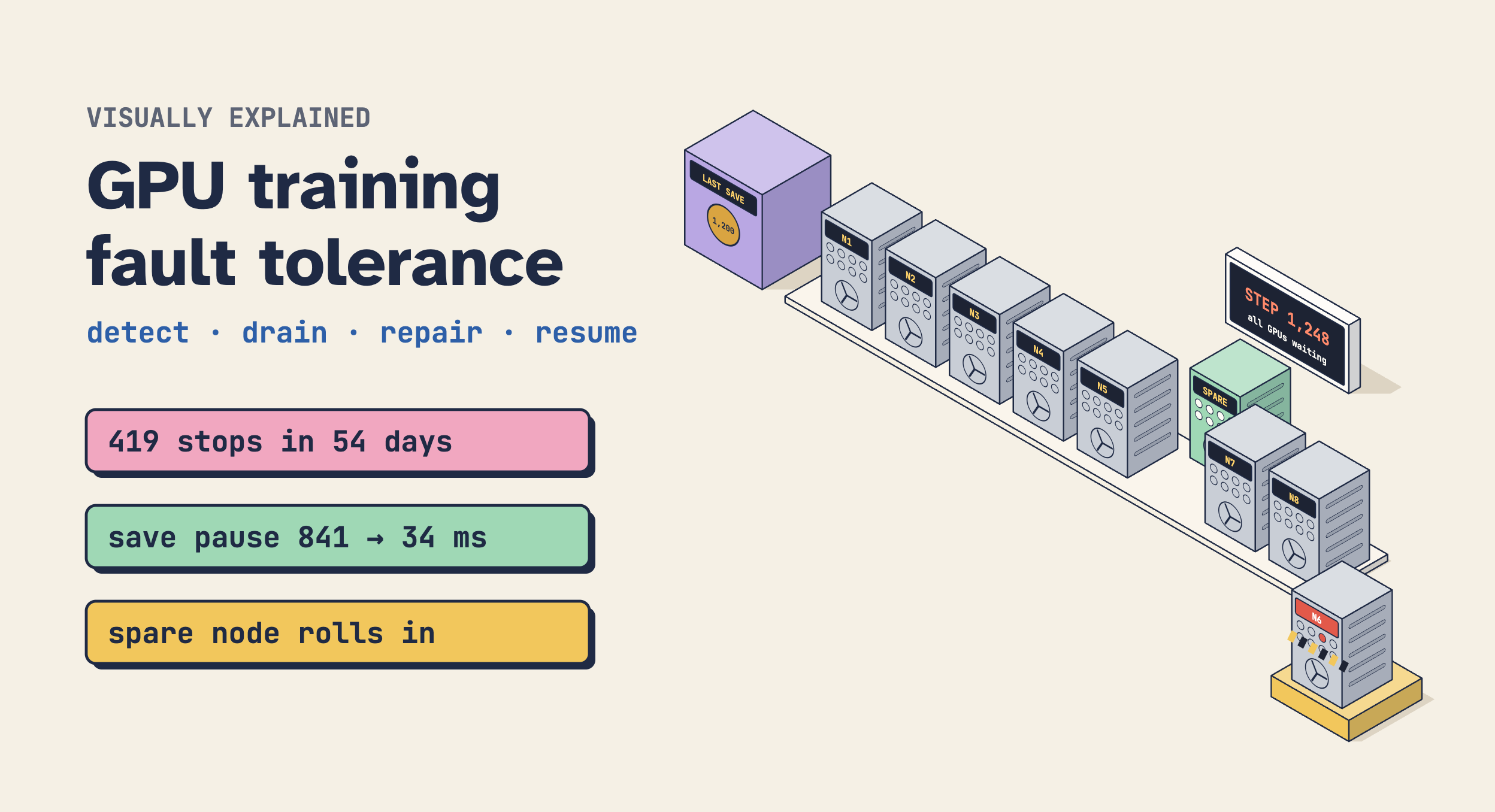
When Meta trained Llama 3 405B on about 16,000 H100 GPUs, it kept count of every stop. Over one 54-day stretch the job was interrupted 466 times. 47 of those were planned maintenance. The other 419 were surprises, and about 78% of them came back to hardware: GPUs, their memory, hosts, cables. That's one unplanned stop roughly every 3 hours, around the clock, for almost two months.
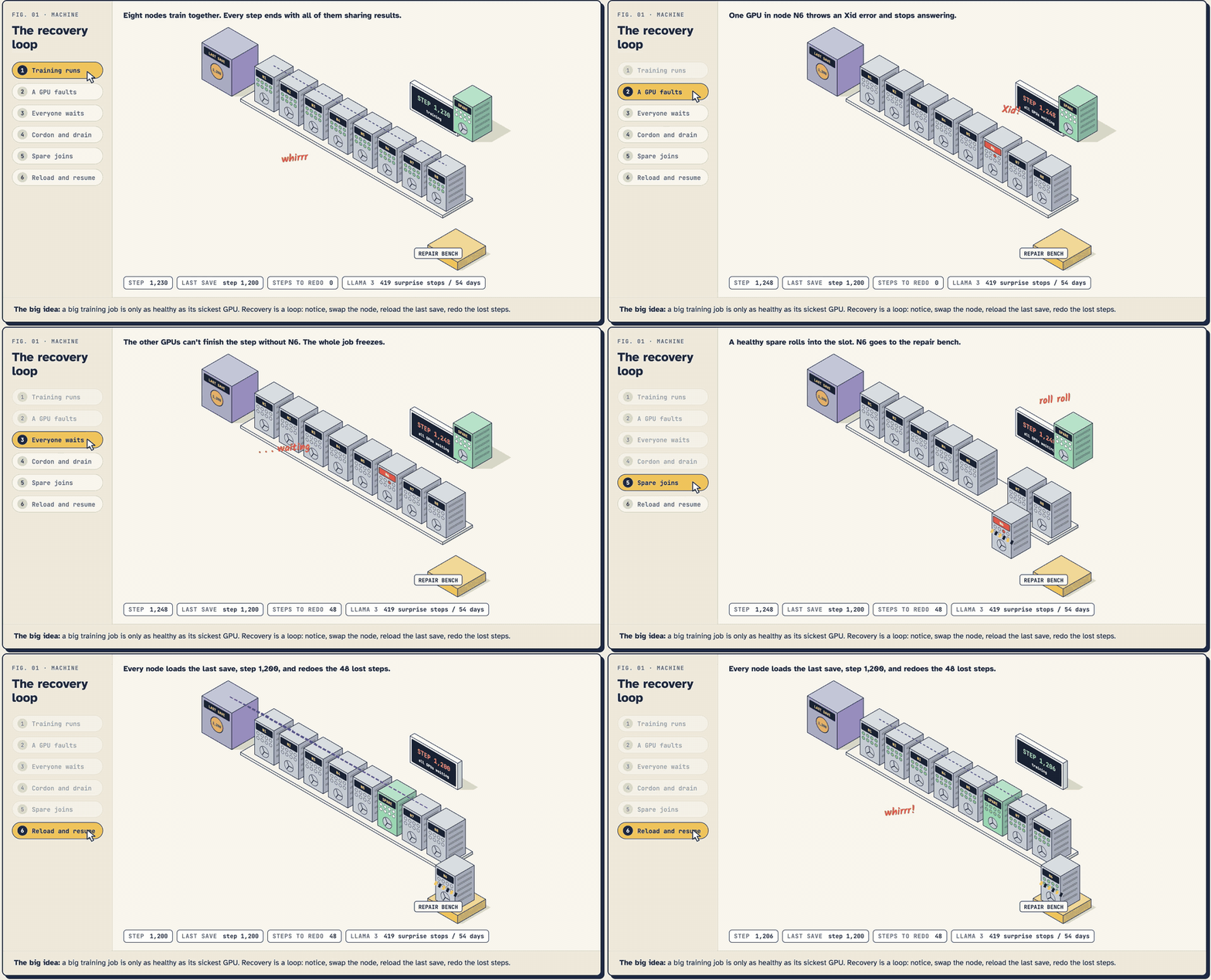
That's normal at this scale, and in the past ten days four teams published how they deal with it. Netflix wrote up the health checks and Kubernetes plumbing behind its GPU fleet. Together AI shipped automatic repair for its GPU clusters. NVIDIA described Minerva, which hunts for GPUs that are sick but not dead. PyTorch's TorchTitan team cut checkpoint stalls from 841 ms to 34 ms. Put together, they describe one machine: detect, drain, repair, resume. This post walks through each part, with the numbers, and the trade-offs that decide how fast a cluster gets back to work.
▶ UPLOAD THE 3D VIDEO HERE: gpu-recovery-3d.mp4
Before we go on: if you're building a career in AI, here's what I'm running right now.
Life of a Model, a free 4-part series. Follow one AI model through its lifecycle: build (pre-training), teach (post-training), tune (fine-tuning, distillation, quantization) and ship (evals, inference, deployment).
Agentic AI Bootcamp for builders and leaders. A new 5-week cohort starts soon. Structure matters, and so does building alongside people who shape AI strategy at the companies you may want to work for. Readers get 35% off.
Storytelling for FDE, 7 hours. The framework that got me into boardrooms with Fortune 100 CEOs and three promotions in five years at Google, shared for the first time. Get $250 off with this link.
Now, back to the machine that keeps 16,000 GPUs training.
