
Session vs Token Auth — A Developer’s Cheatsheet
Deep-dive into stateful sessions, JWTs, OAuth 2.0, and the trade-offs that matter in production

The Identity Problem
HTTP is stateless. Every request your server receives has no memory of who you are. Authentication is the mechanism we bolt on top to fix that. The two dominant approaches are session-based auth (stateful) and token-based auth (stateless). Choosing wrong for your architecture creates real pain at scale.
A useful mental model: session-based auth is like a coat check — you hand the server your identity, get a ticket (session ID), and the server holds everything. Token-based auth is like a signed passport — the document itself carries your identity, and any server can verify it without calling headquarters.
Session-Based Auth (Stateful)
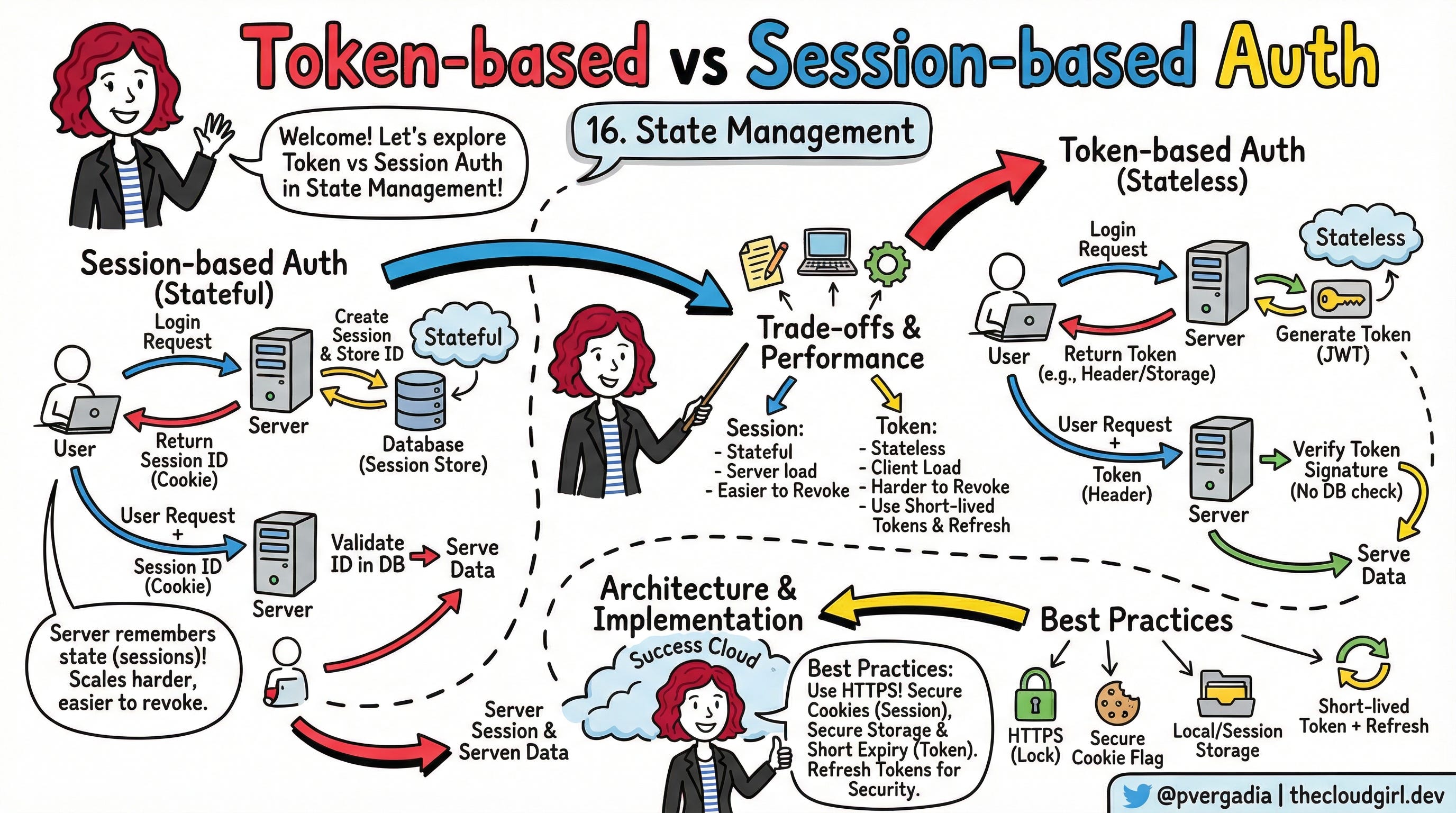
After login, the server creates a session record and sends the client an opaque ID — typically in a cookie. Every subsequent request sends that ID back, and the server looks it up in a store (Redis, a database, in-memory) to retrieve the user’s state.
Request flow:
User sends credentials
Server validates against DB
Server creates session in Redis/DB
Server returns
Set-Cookie: sessionId=abc123Client sends cookie automatically on every request
Server validates ID against session store
Server serves data
The key characteristic: the server owns all the state. This means instant revocation — deleting the session from the store immediately locks out that user. Django’s built-in auth, Flask-Login, PHP sessions — they all work this way.
Where it shines: Traditional server-rendered web apps, admin dashboards, anything where simplicity and instant logout matter. Banking and healthcare apps often prefer this because a compromised session can be killed immediately.
Where it hurts: Horizontal scaling. If you have 10 servers and a user’s session lives on server 3, you either need sticky sessions (routing the user back to server 3 every time) or a shared session store like Redis that all servers can hit. That shared store becomes a bottleneck and a single point of failure.
Token-Based Auth (Stateless)
The server generates a cryptographically signed token — most commonly a JWT (JSON Web Token) — containing all the claims needed (user ID, roles, expiry) and sends it to the client. The client stores it and sends it in the Authorization: Bearer <token> header on every request. The server verifies the signature without any database lookup.
Request flow:
User sends credentials
Server validates, generates signed JWT
Server returns an access token + refresh token
Client stores tokens
Client sends
Authorization: Bearer <token>with each requestServer verifies the cryptographic signature only — no I/O
Access granted
Anatomy of a JWT: It has three Base64-encoded parts separated by dots — a header (algorithm + type), a payload (your claims), and a signature. One critical misconception: the payload is not encrypted, just encoded. Anyone can decode it. Never put passwords, PII, or sensitive data in a JWT payload.
Access vs Refresh tokens: Access tokens are short-lived (15 minutes to 1 hour). Refresh tokens are long-lived (7–30 days) and are only used to get new access tokens when the old one expires. This pattern limits exposure — even if an access token is stolen, it expires quickly.
Where it shines: SPAs, mobile apps, microservices, any cross-domain API. Any server can validate a JWT by checking the signature — no shared store needed. This is why it scales horizontally with zero friction.
Where it hurts: Revocation. You can’t “unsign” a token that’s already been issued. If a user’s account is compromised, you can’t immediately invalidate their JWT unless you maintain a blocklist (which reintroduces state). The standard solution is to keep access tokens very short-lived and rely on refresh token rotation.
OAuth 2.0 — Delegated Authorization
OAuth 2.0 is commonly misunderstood. It is not an authentication protocol — it’s an authorization framework. It lets a third-party app access resources on behalf of a user without ever seeing their credentials. “Login with Google” is OAuth.
The token OAuth issues is typically a JWT. The flow for Authorization Code (the correct modern flow):
Your app redirects the user to Google’s auth server
User authenticates with Google and approves your requested scopes
Google redirects back to your app with a short-lived authorization code
Your backend exchanges that code for an access token + id_token
You use the id_token (a JWT) to identify the user
OAuth vs OpenID Connect (OIDC): OAuth tells you what a user can access. OIDC (built on top of OAuth) tells you who the user is. When you implement “Login with Google,” you’re using OIDC — the id_token is the JWT containing the user’s identity. Always use OIDC for authentication, not raw OAuth.
Grant types to know:
Authorization Code + PKCE — the right choice for web apps and SPAs. Code is exchanged server-side.
Client Credentials — machine-to-machine. No user involved. Your microservices talking to each other.
Implicit — deprecated. Don’t use it.
Password Grant — deprecated. Required sending user credentials to the third party. Avoid.
Head-to-Head Trade-offs
Dimension Session-Based Token-Based State location Server (Redis/DB) Client Scalability Needs shared store Trivially horizontal Revocation Instant Hard without blocklist Server load DB hit every request Crypto verify, no I/O XSS resistance HttpOnly cookie Risk if stored in localStorage Cross-domain Needs CORS config Works natively in headers Microservices Shared store required Each service validates independently Mobile apps Cookie handling is tricky Headers are simple Payload size Tiny session ID JWT can be 300–2000 bytes
When to Use What
Use session-based auth when building traditional server-rendered apps (Django, Flask, Rails), when you need instant revocation (banking, healthcare, enterprise), or when simplicity is a higher priority than scalability.
Use JWT token auth when building REST APIs consumed by SPAs or mobile apps, when operating microservices where a shared session store is undesirable, or when you need cross-domain SSO.
Use OAuth 2.0 + OIDC when delegating authentication to an identity provider (Google, GitHub, Auth0), or when building a platform that third-party apps need to access on behalf of users.
The real answer: Many production systems use both. A web app might use session-based auth for the browser UI and issue short-lived JWTs for its mobile API. Understand the trade-offs, then make a deliberate choice based on your constraints — not trends.
Security Best Practices
For session auth: always use HttpOnly + Secure + SameSite=Strict cookies. Regenerate the session ID after login to prevent session fixation. Set short idle timeouts. Store sessions in Redis with TTL, never in-memory on a single process.
For token auth: keep access tokens short-lived (15 minutes max). Implement refresh token rotation — when a refresh token is used, invalidate it and issue a new one. Use RS256 (asymmetric keys) over HS256 in multi-service architectures so services can verify without sharing the signing secret. Validate iss, aud, and exp claims explicitly.
On token storage: localStorage is vulnerable to XSS — any injected script can steal your token. The modern consensus is to store access tokens in JavaScript memory (a variable, not persisted) and refresh tokens in httpOnly cookies. You get XSS resistance from the cookie and CSRF protection from the fact that the access token isn’t in a cookie.