
Single Agent vs Multi-Agent Architecture Visually Explained
Single Agent vs Multi-Agent Architecture Cheatsheet

Every team building with agents eventually hits the same wall: one agent, however capable, can only do one thing at a time. It reasons, picks a tool, waits for the result, reasons again, picks another tool. For a simple lookup, that’s fine. For something like “analyze our competitors in the AI coding assistant space,” that single agent has to research product features, pull pricing data, read reviews, and write a report, all in one long serial chain, with no way to work on two of those things at once.
The failure mode is dramatic, slow, and wrong. The agent forgets what it found three tool calls ago. It runs out of context budget halfway through. Nobody catches the mistake because there’s no second agent checking the first one’s work.
This is where multi-agent systems come in, and where a lot of teams either overcorrect into unnecessary complexity or undercorrect and keep duct-taping a single agent that was never built for the job.
We will go through each architecture one-by-one and at the end I will give you a complete visual of the difference!
What a single agent actually is
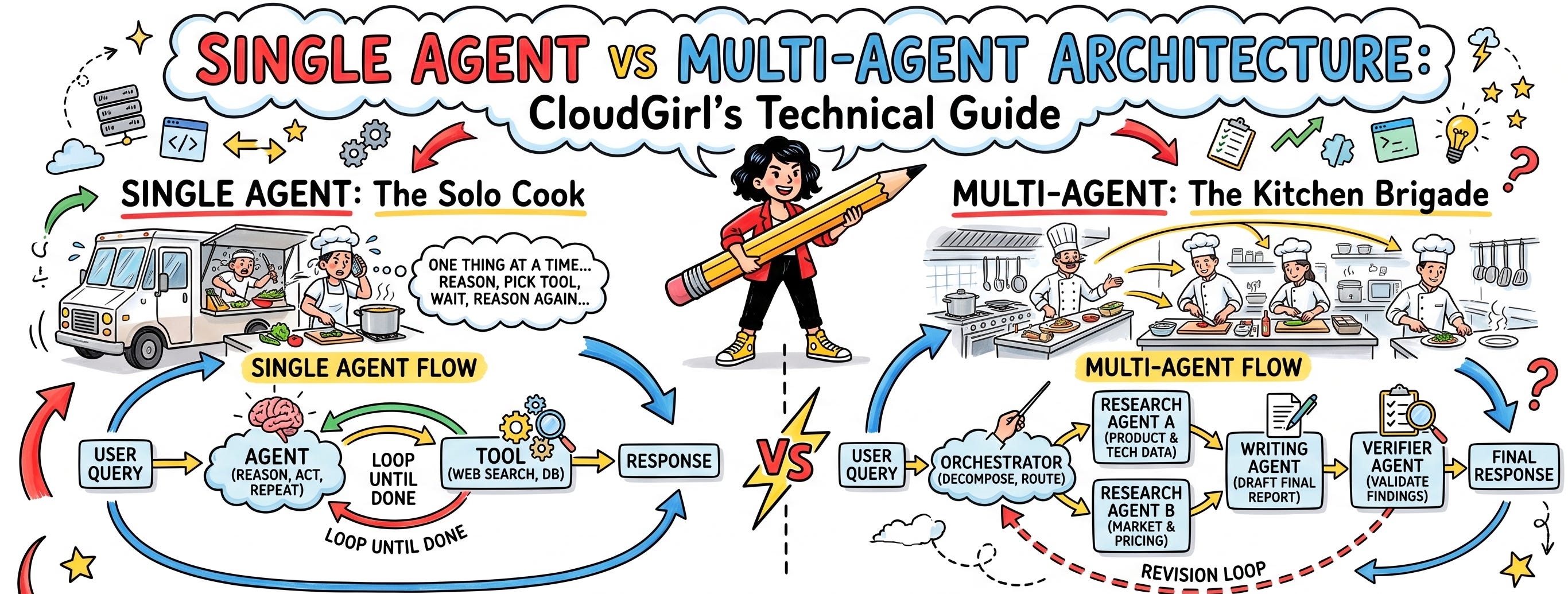
Picture a solo cook running a small food truck. One person takes the order, checks the fridge, chops the vegetables, cooks the dish, plates it, and hands it over. There’s no handoff, no division of labor. It works beautifully for a short menu.
A single-agent system works the same way. One reasoning loop, usually built around an LLM, sits at the center. It receives a query, decides what it needs, calls a tool such as web search or a database, reads the result, and decides again whether it has enough information or needs another round. This loop repeats until the agent is confident enough to answer.
The architecture is simple: one control loop, one model doing the reasoning, one place where state lives. You can trace exactly why it made a decision because there’s only one decision-maker.
Single agent flow: User query → Agent (reason, act, repeat) ↔ Tool (web search, database) → Response. The agent and tool loop back and forth until the agent has enough information to answer.
That loop is also exactly where things fall apart. The agent has one context window, one memory, one thread of reasoning trying to hold research, analysis, and writing all at once. Ask it to do three unrelated things and it does them one after another, dragging all the baggage from step one into step three.
What multi-agent actually is
Now picture a real kitchen during service. A head chef doesn’t cook every dish personally. They look at the order, decide which station handles what, and let the grill cook and the pastry chef work in parallel. Someone expedites at the pass, checking every plate before it goes out. Nobody does everything; everyone does one thing well, and the head chef keeps it all moving in the right order.
