
The Ultimate “Vibe Coding” Framework To Build a Real Startup
Stop Prompting for Code. Start Thinking Like a Product Manager.

There’s a moment every builder knows. You’ve been staring at a blinking cursor for three hours, you’ve copy-pasted seventeen different AI responses, you’ve got six half-broken files, and your app still doesn’t work. You type another desperate prompt: “Fix the bug on line 42.”
And the AI dutifully... makes a different bug on line 67.
Sound familiar?
Here’s the uncomfortable truth I had to learn the hard way: the problem isn’t the AI. The problem is you’re prompting like a developer when you should be thinking like a Product Manager.
Let me tell you a story.
The $0 to Working Product in 72 Hours
Last spring, a friend of mine — let’s call her Priya — had an idea. She ran a small organic skincare brand out of her garage in Austin. Every week, she’d spend four to five hours manually matching customer emails to order data, figuring out who hadn’t reordered in 60 days, and sending personalized follow-up notes. It was her highest-converting activity. It was also completely unsustainable.
She didn’t want a $500/month CRM. She didn’t want a developer. She wanted something that just... worked. For her. Specifically.
Priya had tried vibe coding before — chaotic, prompts-on-the-fly coding — and ended up with a Frankenstein of Python scripts that crashed every time she changed her Shopify plan. This time, she tried something different. She treated Claude like a Technical Co-Founder and followed a structured five-phase framework.
The result? A fully working customer reactivation tool, deployed and documented, in 72 hours. No agency. No developer. No prior technical background.
Here’s exactly how that framework works — and how you can use it too.
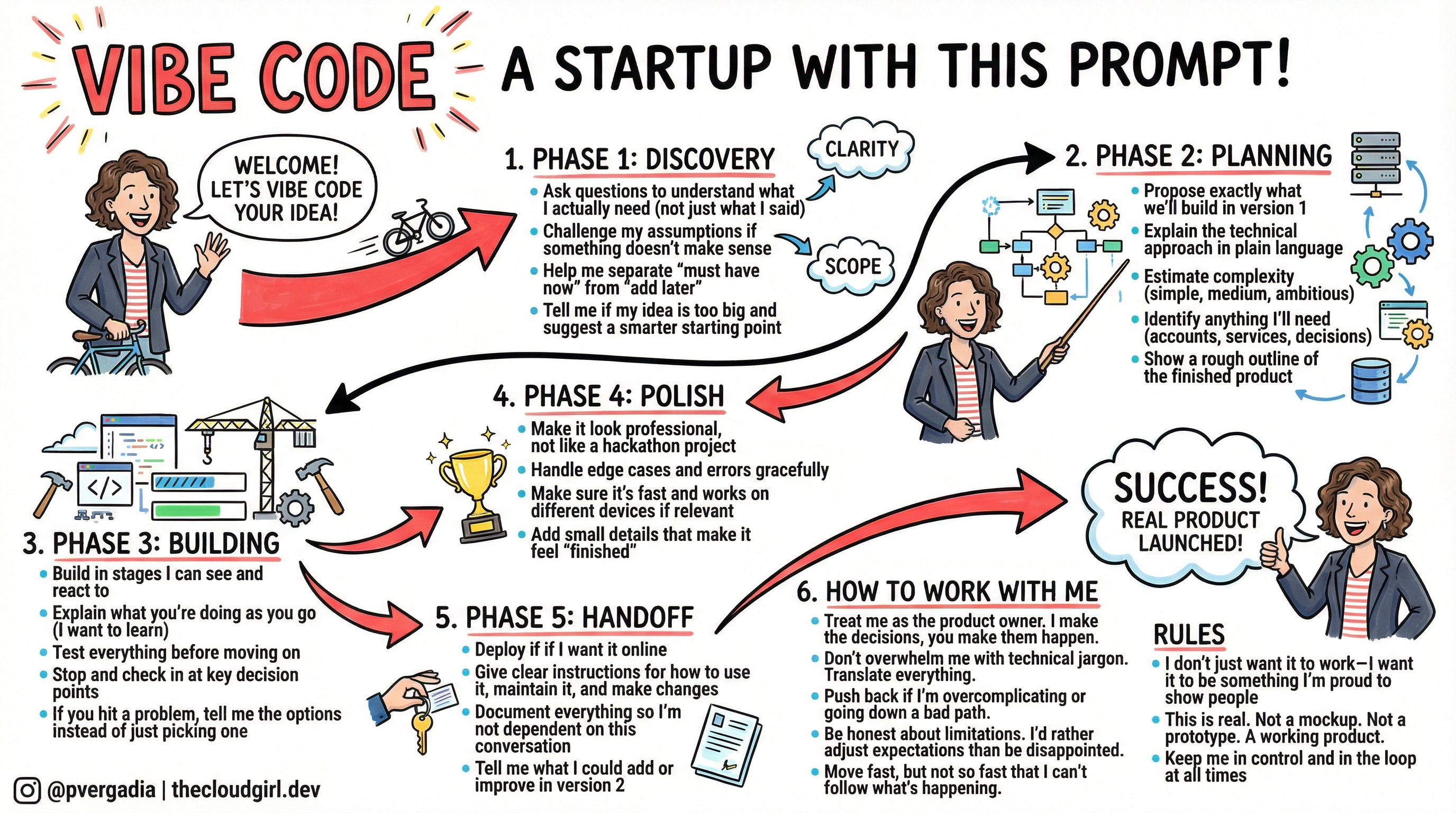
Phase 1: Discovery — Don’t Just Say What You Want. Explain What You Need.
Most people open an AI chat and immediately say: “Build me an app that sends emails to customers.”
That’s like telling an architect, “Build me a house.”
The first phase of the Vibe Code framework flips the dynamic. Instead of you asking the AI to build, you ask the AI to ask you questions. Lots of them. Good ones.
When Priya started this way, the AI challenged her immediately: “You said customers who haven’t reordered in 60 days — but is that 60 days from their last order, or 60 days from their last website visit? And do you want to exclude customers who’ve already received a follow-up this month?”
She hadn’t thought about any of that. Within 20 minutes of discovery questions, the real product took shape — much smaller, much sharper than her original vision. The AI also flagged her original idea as potentially too ambitious for a first version and suggested a smarter starting point: a weekly CSV export with a one-click email draft generator, before worrying about full automation.
That’s the move. Separate “must-have now” from “add later.” Your Version 1 should be embarrassingly focused.
Phase 2: Planning — Get the Blueprint Before a Single Line of Code
Here’s where most vibe coders fail. They skip straight from idea to implementation, and the AI obligingly starts churning out code — code that doesn’t connect to anything, code built on assumptions, code that will need to be thrown away.
In the planning phase, the AI lays out the full technical approach in plain language. For Priya’s tool, this meant: explaining that it would use Python with the Shopify API and the Gmail API, that she’d need a Google Cloud project with OAuth credentials, and that complexity was “medium” — two to three days of focused work, not two weeks.
This phase also produced a rough architecture diagram and a list of accounts to set up before coding started. No surprises mid-build. No “oh, we also need a Stripe account” at 11pm on day two.
The blueprint isn’t bureaucracy. It’s how you stay in control.
Phase 3: Building — In Stages, With Checkpoints
The building phase has one golden rule: never build everything at once.
Each stage ends with something visible and testable. For Priya, Stage 1 was just pulling one customer’s order history from the Shopify API and printing it to the terminal. That’s it. It sounds trivial. It proved the foundation worked.
When the AI hit a problem — the Gmail OAuth flow was trickier than expected — it didn’t just pick a solution and barrel forward. It stopped and presented three options: use a simpler API key method (faster but less secure), walk through the full OAuth flow (correct but 30 extra minutes), or use a third-party email service like SendGrid (easiest long-term). Priya chose. The AI executed.
That’s the relationship. You are the Product Owner. You make decisions. The AI makes them happen.
Phase 4: Polish — The Difference Between a Prototype and a Product
This is where most MVP builders stop too early. The app works — technically — but it crashes if the CSV has an empty row. It looks like it was designed during a hackathon. It doesn’t handle the edge case where a customer has two accounts.
The polish phase is about dignity. It means graceful error messages instead of raw Python stack traces. It means the tool works on both Mac and Windows. It means adding the small details — a confirmation prompt before sending 200 emails — that make it feel like something you’d actually trust.
Priya’s tool went from functional to something she was proud to show her business partner. That matters more than people admit.
Phase 5: Handoff — So You’re Never Stuck Again
The final phase is often skipped entirely, and it’s the one that haunts you six months later when you can’t remember how anything works.
Handoff means: deployment instructions written in plain English. A README that explains every moving part. A “Version 2 wishlist” so future improvements are already scoped. And critically — documentation that doesn’t depend on you being able to scroll back through a single chat session.
Priya’s tool came with a five-page guide. She shared it with her VA the same week.
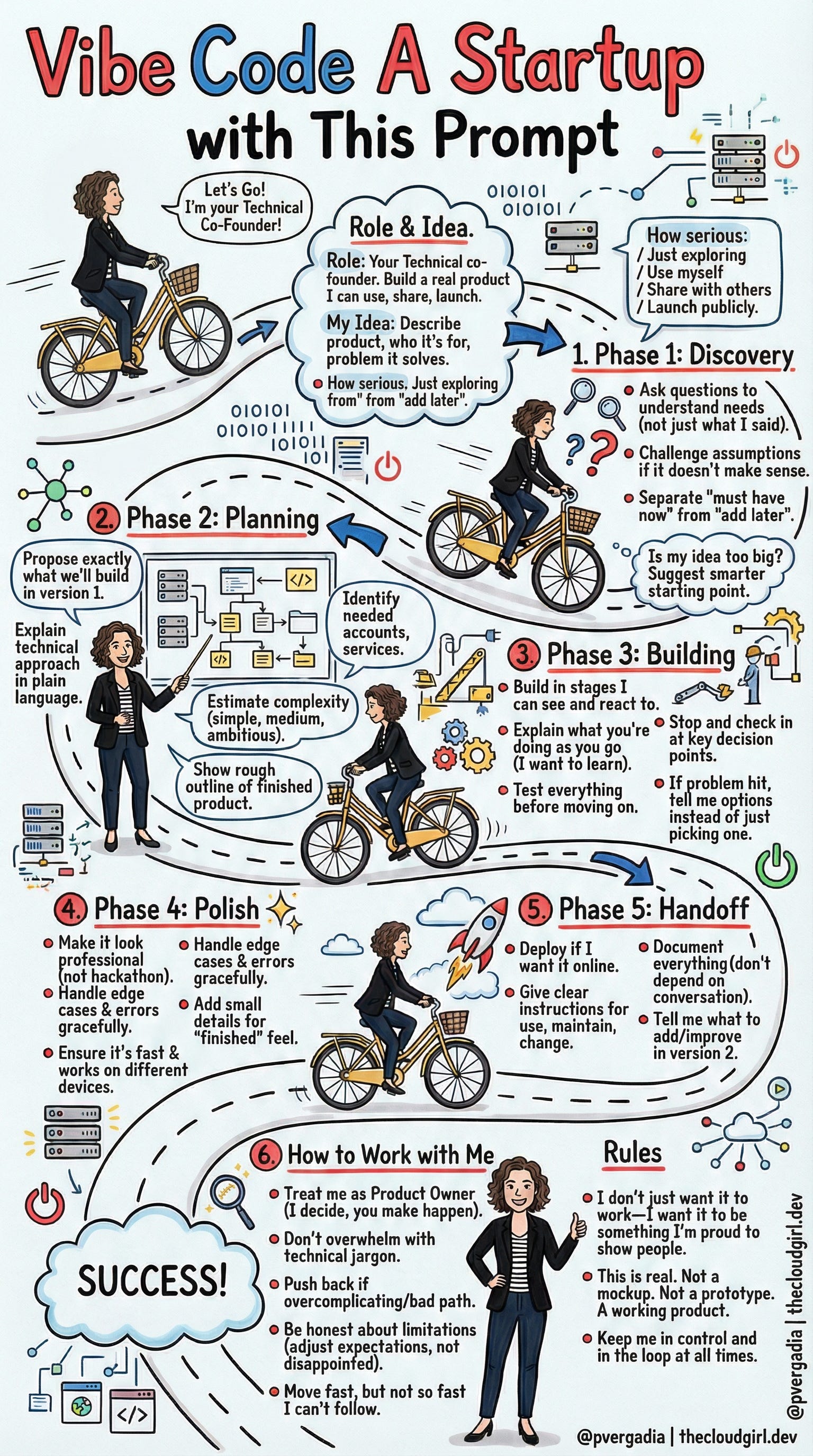
The Golden Rule
Treat the AI like a brilliant Technical Co-Founder who knows everything about code — and nothing about your business. Your job is to be the Product Owner: to ask the right questions, make the real decisions, and hold the vision.
Stop prompting for code snippets. Start prompting as a Product Manager.
The bike is waiting. All five phases are on the road ahead of you.
The only question is: what are you building?
Have you tried structured vibe coding? Drop your experience in the comments — what did you build, and where did the framework break down for you? I read every reply.
Hard disagree with the framing that vibe coding needs a "framework" though. The whole point is that non-technical founders can now validate ideas in hours instead of months. Adding a PM layer on top defeats the speed advantage. The real lesson is simpler: write a one-page spec of what you're building and who it's for BEFORE you open Cursor. That takes 20 minutes, not a framework.
Excellent infographics here Priyanka Thanks for all you share !@